
Thread lift
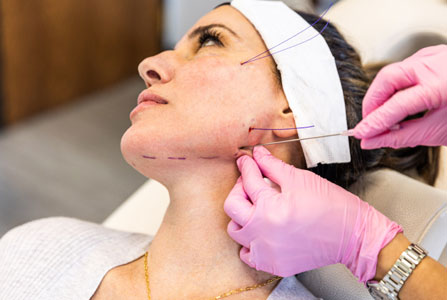
Thread lift
A thread lift is a minimally invasive aesthetic procedure in which specially designed dissolvable threads are inserted beneath the skin to achieve lifting, tightening, and rejuvenation of facial tissues.
Call Now! Book an Appointment!What is it?
A thread lift is a minimally invasive aesthetic procedure in which specially designed dissolvable threads are inserted beneath the skin to achieve lifting, tightening, and rejuvenation of facial tissues.
The procedure works through two important mechanisms:
Immediate lifting effect
Barbed or cog threads mechanically reposition sagging tissues by anchoring to the underlying soft tissue, creating an immediate tightening and lifting effect.
Regenerative effect
Once the threads are placed, the body naturally responds by stimulating fibroblast activity and collagen production around the threads. This improves:
- Skin elasticity
- Firmness
- Texture and skin quality over time
Even after the threads dissolve, the collagen stimulation may continue to provide a rejuvenating effect for several months.
Common names for this procedure
- Thread lift
- PDO thread lift
- Non-surgical facelift
- Suture lift
Am I eligible for it? (Patient selection)
Ideal candidates
- Mild to moderate facial skin laxity
- Early signs of aging
- Mild sagging of cheeks, jawline, or neck
- Patients desiring subtle lifting without surgery
Not ideal for
- Severe skin sagging
- Very heavy facial tissues
- Unrealistic expectations
- Active skin infection or inflammation
Thread lifts are best suited for patients seeking natural-looking rejuvenation with minimal downtime.
Symptoms / Indications
Thread lift may be used in:
- Facial skin laxity
- Early jowling
- Mild jawline sagging
- Nasolabial folds
- Midface descent
- Brow ptosis
- Mild neck laxity
Common treatment areas include:
- Cheeks
- Jawline
- Brow area
- Neck
- Under-eye and midface region (selected cases)
List of screening / investigations
Clinical assessment
- Detailed facial analysis
- Assessment of skin laxity and symmetry
- Skin quality and elasticity evaluation
- Standardized clinical photographs
Medical screening
- Medication history
- Bleeding tendency or anticoagulant use
- Allergy history
- Allergy history
👉 Routine radiological scans are generally not required.
Pre-procedure care
- Detailed informed consent
- Clinical photographs
- No makeup on procedure day
- Avoid alcohol prior to procedure
- Avoid blood thinners/NSAIDs if medically advised
- Skin should be free from active infection
Patients should be counselled regarding:
- Expected degree of lift
- Temporary swelling or bruising
- Realistic outcomes and longevity of results
Procedure overview
The procedure is usually performed under topical or local anesthesia.
- Treatment vectors are marked
- Threads are inserted using a fine needle or cannula into the subcutaneous plane
- Barbed threads engage the tissues to create lifting
- Procedure duration is approximately 30–45 minutes
Most procedures are performed as an OPD/day-care procedure.
Post-procedure care
- No makeup for 24–72 hours
- Avoid vigorous exercise for 3–5 days
- No sauna, steam, facial massage, or spa treatments for 7–10 days
- Avoid sleeping on the face or side initially
- Sleep with head elevated
- Avoid excessive facial movements
Mild swelling, bruising, tightness, or tenderness may occur temporarily.
Benefits of the procedure
- Minimally invasive with no major scars
- Immediate lifting and tightening effect
- Stimulates collagen production
- Improves skin structure and elasticity
- Short recovery time
- Natural-looking rejuvenation
- Can delay the need for surgical facelift
Results are usually visible immediately, with progressive improvement over the following weeks as collagen remodeling occurs.
Risks / Possible complications
Although generally safe, possible side effects include:
- Swelling
- Bruising
- Mild pain or tenderness
- Skin dimpling
- Asymmetry
- Palpable or visible threads
Rare complications include:
- Infection
- Thread migration or extrusion
- Contour irregularities
- Persistent pain
Patients should seek medical attention if they develop:
- Fever
- Increasing redness or swelling
- Persistent discharge
- Severe pain
Duration of results
Results are not permanent. Depending on thread type and patient factors:
- Threads gradually dissolve over months
- Effects typically last approximately 1–3 years
- Collagen stimulation may prolong the rejuvenation effect even after thread dissolution